 En
En
 عربى
عربى 中文简体
中文简体

At a coal-fired or combined-cycle power plant, the water treatment team usually identifies problems by the symptoms: a thin layer of calciu...
READ MORE
Home / Catalog Of Water Treatment Related Chemicals
Catalog Of Water Treatment Related Chemicals
Download Catalog
| System/Use | Product Name | Technical Parameter | Packing |
| Coagulants/Flocculants | PAC | Industrial grade/content: ≥ 28% Drinking water level/content: ≥ 30% |
25kg plastic bag woven bag |
| Al₂(SO₄)₃ | Solid particles or flakes/content: 16.5% | 25kg plastic bag woven bag | |
| Coagulant aid | APAM | Anionic/white or slightly yellow particles/6 million to 18 million molecular weight/solid content: ≥ 88.5%/hydrolysis degree: 24.0 to 28.0% | 25kg plastic bag woven bag |
| CPAM | Cationic/white or slightly yellow particles or powder/Molecular weight: ≥ 6 million/Ionicity: 40-50%/Solid content: ≥ 88% | 25kg plastic bag woven bag | |
| Big brown chemicals | CH6N4O | Boiler deoxidizer/solid/content: 98% min | 25kg cardboard drum/5kg cardboard box |
| NaHSO₃ | Reverse osmosis reducing agent/solid white crystalline powder/ Main content (calculated as SO2): 64.0~67.0% |
25kg plastic bag woven bag | |
| HCl | Meet the national standard GB320 | Conventional is ton barrels, customizable | |
| H2SO4 | Meet the national standard GB/T534 | Conventional is ton barrels, customizable | |
| Alkali (solid/liquid) | Meet national standards GB/T209 or GB/T11199 | Solid standard is 25kg plastic bag woven bag The standard liquid is ton barrels, which can be customized | |
| NH3·H2O | Industrial grade: meets HG/T 5353 Reagent level: Meets GB/T631 |
Conventional is ton barrels, customizable | |
| Chemical reagent | Chemical reagent | Chemical grade, analytical grade, premium grade, reference grade, etc | Bottled, classified according to reagents |
| High purity gas/standard gas | High purity gas/standard gas | Various types of pure gas, mixed gas/purity up to 99.999% | 8L, 10L, 40L and other steel cylinders |
Since 1991
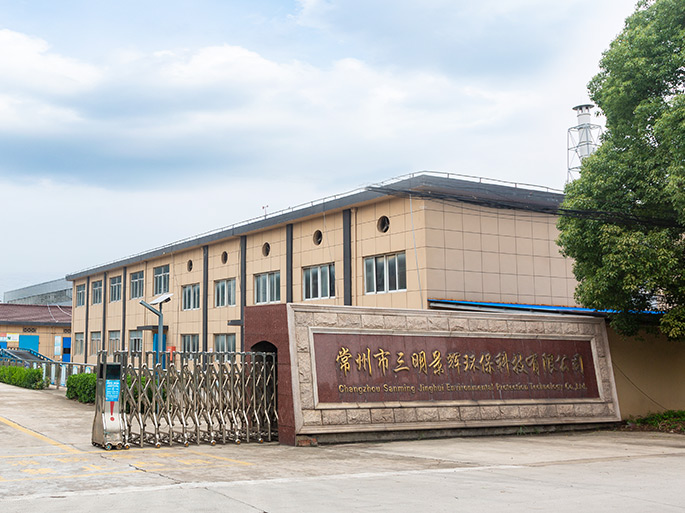
Changzhou SanmingJingHui Environmental Protection Technology Co., Ltd.
Changzhou SanmingJingHui Environmental Protection Technology Co., Ltd. (formerly Changzhou Sanming Chemical Co., Ltd.) is a high-tech, environmentally friendly and energy-saving water treatment agent professional enterprise integrating scientific research and development, production and sales, and technical services. It was founded in 1991.
The company is located in the central area of the Yangtze River Delta, close to the Shanghai-Nanjing Railway and the Beijing-Hangzhou Grand Canal, and is located in Hengshanqiao Town, the middle intersection of the Shanghai-Nanjing Expressway. It is only half an hour away from Changzhou Civil Aviation Airport and has convenient transportation. It has fixed assets of more than 18 million yuan, more than 20 scientific researchers, and 25% of employees have obtained various professional and technical titles.
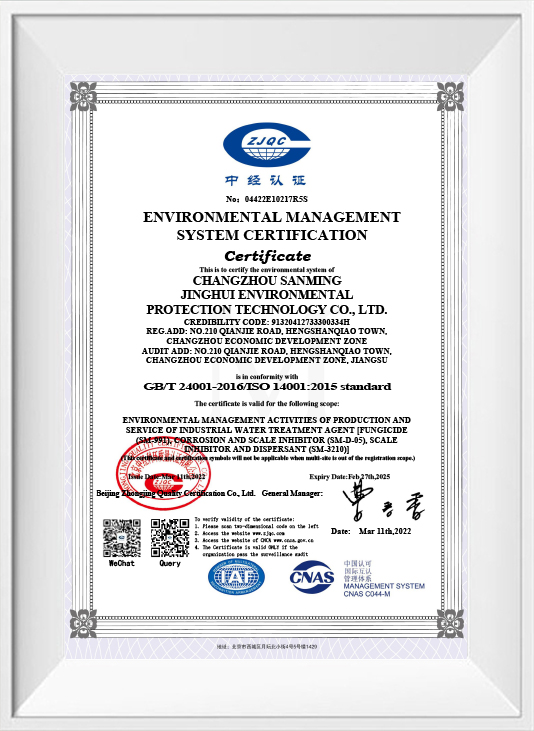
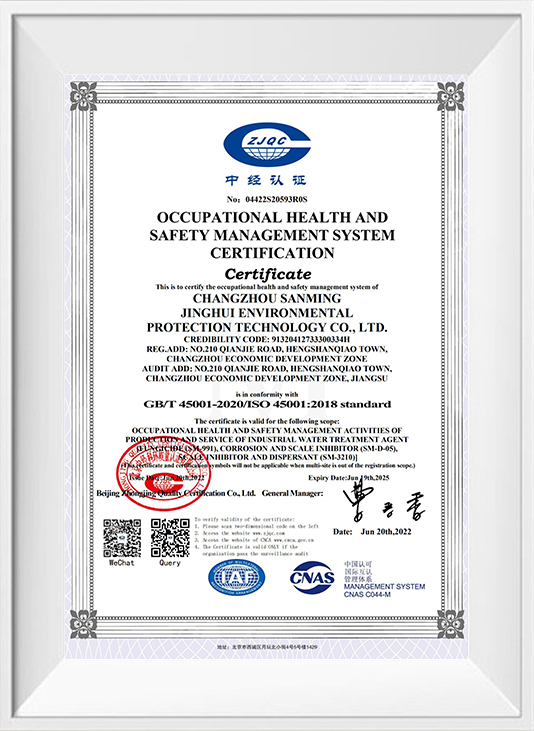
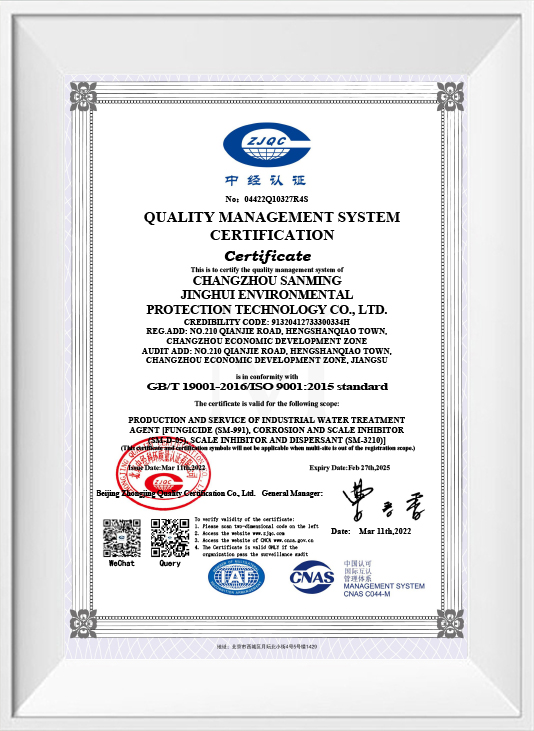
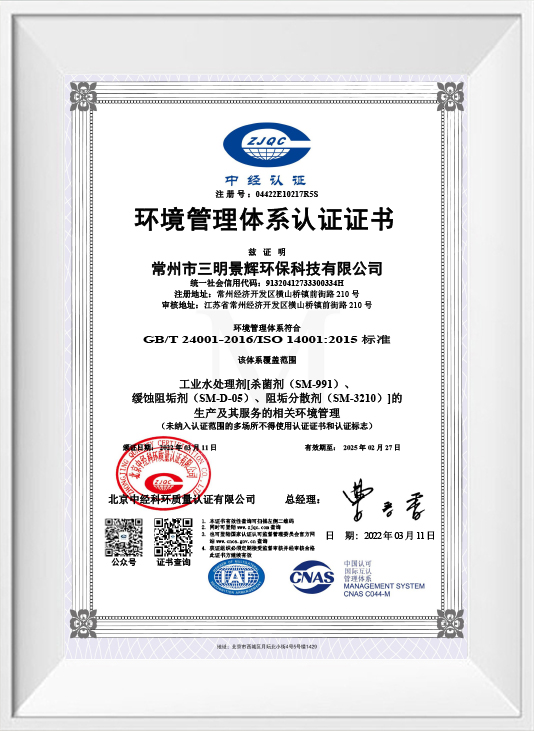
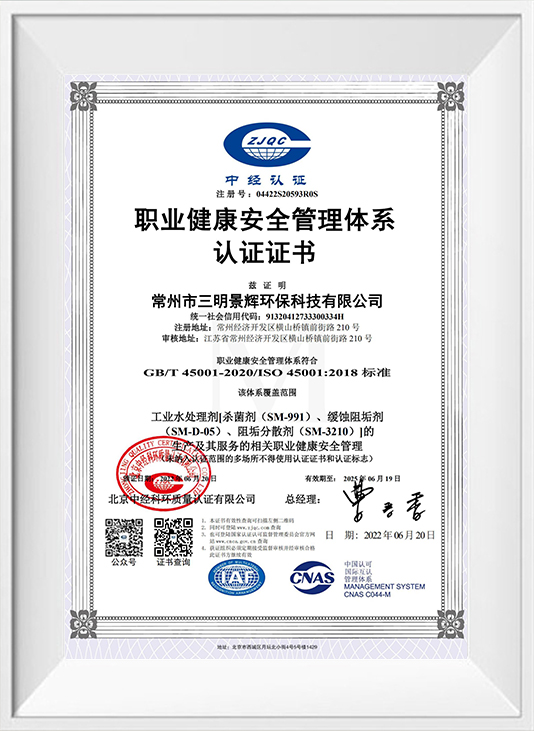
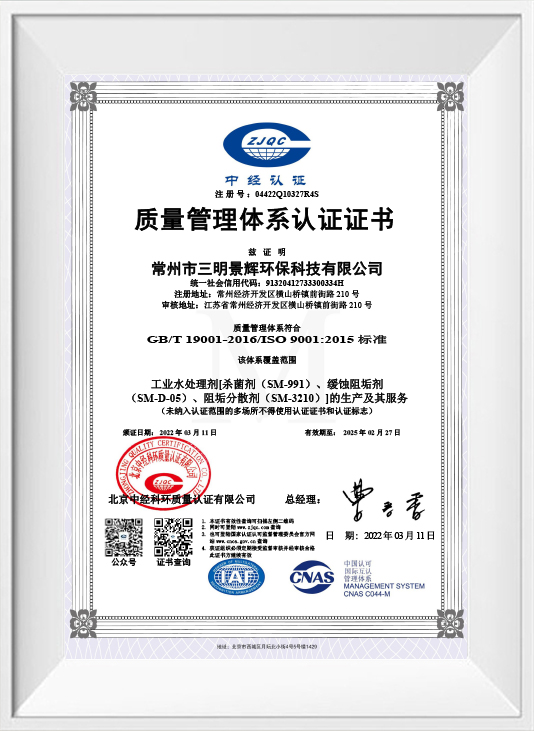
Our Proven Management System
As a professional water treatment solutions company, we can provide support at every level our customers need, including factories, R&D technical teams, local sales branches, etc.
Media
-
-
Two identical industrial RO skids installed the same year can tell very different stories: one replaces its membrane elements after 18 mont...
READ MORE -
A facility engineer walks up to a reverse osmosis (RO) skid that has been in service for 38 months. Normalized permeate flow is down 13 per...
READ MORE -
Pharma water treatment follows one working rule: the equipment defines the theoretical purity, but the chemical program decides the purity ...
READ MORE -
When a facility receives its quarterly wastewater report and sees an unexpected number on the chromium line, the first instinct is to look ...
READ MORE
More product information about Catalog Of Water Treatment Related Chemicals
Coagulation and Flocculation: The Two Key Players in Water Treatment
In the field of water treatment, "coagulation" and "flocculation" are two terms you hear all the time, but their differences and applications are often misunderstood. Let’s break it down in simple terms!
What is Coagulation?
Coagulation refers to the process of adding coagulants to neutralize the charges on colloidal particles and suspended solids in water, causing them to aggregate into tiny clusters. This is the first step in water purification and lays the foundation for subsequent processes.
What is Flocculation?
Flocculation takes the baton from coagulation! After coagulation, flocculants are added to help those initial clusters (known as "flocs") grow larger, eventually forming visible “macro flocs.” These larger flocs can then be removed through sedimentation or filtration, leaving behind clear water.
Applications of Coagulation and Flocculation
From purifying drinking water to treating industrial wastewater, these two processes play a crucial role in removing contaminants and improving water quality. Our high-performance water treatment chemicals are specifically designed for these processes to deliver optimal results. For example:
Coagulants: Quickly eliminate colloidal particles in water and reduce turbidity.
Flocculants: Improve floc sedimentation efficiency for crystal-clear water.
How to Choose the Right Water Treatment Chemical?
Choosing the right water treatment chemical is crucial! Different water conditions require tailored product combinations. With years of R&D experience, we can provide customized solutions to help you achieve efficient and cost-effective water treatment goals.
Making Water Treatment Simple and Efficient!
Whether it’s coagulation or flocculation, the magic of water treatment lies in these seemingly simple chemical reactions. We are dedicated to delivering clean, energy-saving water treatment experiences with our cutting-edge eco-friendly products. Want to know more? Contact us today!
Stay connected.
This is a simple way to stay informed.
Contact information
- No.210, Qianjie Rd, Hengshanqiao Town, Changzhou Economic Development Zone, Jiangsu Prov, China
- +86-18015080980 / +86-519-88612610
- [email protected]
Quick Links
Keep in touch
Wholesale Coagulant Chemicals Manufacturers
© 2024 Changzhou SanmingJingHui Environmental Protection Technology Co., Ltd. All Rights
Reserved.
